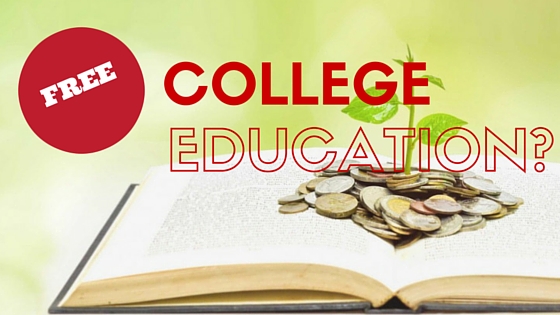
There is no doubt that the rising price of higher education has become a concern of politicians, but is the solution to make it free? The College Board recently reported data indicating the published price for tuition, room and board has increased an inflation adjusted 10% over the past five years. At a typical public state college students faced a $19,548 price tag in 2015. Those choosing a private non-profit school are swallowing an average of $43,921 per year for tuition, fees, room and board. Even after accounting for institutional tuition discounts, grants and federal tax aid, the net prices continue an upward climb.
Many students rely on student loans to cover their college costs. One analyst estimated the class of 2015 is expected to produce graduates with an average student loan debt of $35,000. This is up from just under $30,000 in 2013. Despite the mounting debt, a college education does provide an economic payback. A 25-year old with a four-year degree in 2013 was expected to earn 65% more over a lifetime then his/her peer with only a high school degree. A college education also provides an important developmental function for young adults, as they develop a network of friends and relationships that last a lifetime with both social and economic benefits.
Making college more accessible and affordable is a noble goal, which includes advancing lower-cost options. During the 2016 election cycle one Presidential candidate has advocated for a tuition-free public college education for all qualified students. Senator Bernie Sanders proposed to pay for free college education model by taxing equity and bond trades, calling it a “Robin Hood Tax on Wall Street.” Other candidates suggest his plan is unworkable.
In an article titled, “Making College ‘Free’ Will Only Make It More Expensive” author Anne Bradley reminds us that there is such thing as a free lunch. “Making college free of charge doesn’t make it free to provide,” claims Bradley. Someone has to pay. She goes on to argue that making college free actually makes it more costly to provide as more people will consume college who are neither interested, prepared nor suited. Some will persist, but many will taste and then withdraw or drop out. This follows economic logic born out in experience: overconsumption drives up costs and ultimately leads to scarcity. Hence, taxes are increased to redistribute income to many who drop out and never benefit, input costs rise and suppliers leave the market. This is not an efficient model. Prices provide important signals to the market regarding relative scarcity of an item.
Bradley concludes that market-based competition among suppliers and innovative solutions are more efficient at allocating education resources. “That means opening more universities or providing professional certificates and vocational schooling. This competition will also drive down prices of higher education over time,” concludes Bradley.
Some of the emerging innovations that lower the total cost of higher education include dual-enrollment and competency-based education. Dual enrolled students earn college credit while taking certain high school courses taught by college professors. Competency-based models allow students to earn credit for what they already know, enabling them to graduate sooner and with fewer courses for which to pay tuition.
Competition, innovation and entrepreneurial initiatives from suppliers of college credit, combined with a more knowledgeable and savvy consumer of the college experience are the forces that will make higher education more affordable. Making college tuition free through government subsidization will lead to less innovation as it will entrench the establishment. It will also cause budgets to bloat, bureaucracy to expand, and ultimately increase scarcity. A system of a college education free to the student, will end up with the payer—in this case the Federal Government—deciding who gets to go to college and what is taught.
Comments
24 responses to “Should College Tuition Be Cost Free? The High Cost of Free College Education”
mebeverine hcl
mebeverine hcl
lasix generic
lasix generic
mobic for hip pain
mobic for hip pain
vibramicina
vibramicina
lasix pills for dogs
lasix pills for dogs
what is vidalista 80
what is vidalista 80
viagra age range
viagra age range
loperamide child dose
loperamide child dose
tadalafil affect sperm
tadalafil affect sperm
is avanafil over the counter
is avanafil over the counter
is proscar an immunosuppressant
is proscar an immunosuppressant
doxycycline for acne reddit
doxycycline for acne reddit
flagyl dosage for sinus infection
flagyl dosage for sinus infection
bupropion hcl er reddit
bupropion hcl er reddit
terbinafine complete overview
terbinafine complete overview
toradol migraine dosing
toradol migraine dosing
ivermectin comprehensive guide
ivermectin comprehensive guide
ivermectin scabies anti‑mite
ivermectin scabies anti‑mite
sildenafil clinical contraindications
sildenafil clinical contraindications
sildenafil food‑linked absorption delay
sildenafil food‑linked absorption delay
otitis media viral infection
otitis media viral infection
Sildenafil Onset Guide
Sildenafil Onset Guide
Brand vs Generic Approval Standards
Brand vs Generic Approval Standards
SildenafilCentral.com
SildenafilCentral.com